Why You Should Never Read a CV Again: The Power of Structured Candidate Data
Modern applicant tracking systems use AI to automatically parse CVs into structured candidate data, meaning you can stop reading files and start making decisions.
Every recruiter knows the drill. A promising CV lands in your inbox. You open the PDF, scroll through pages of inconsistent formatting, hunt for the relevant experience buried between hobbies and a two-page personal statement, and manually copy contact details into your system.
Now multiply that by 50 applications. Per job opening.
There's a better way. Modern applicant tracking systems use AI to automatically parse CVs into structured candidate data, meaning you can stop reading files and start making decisions.
What is structured candidate data?
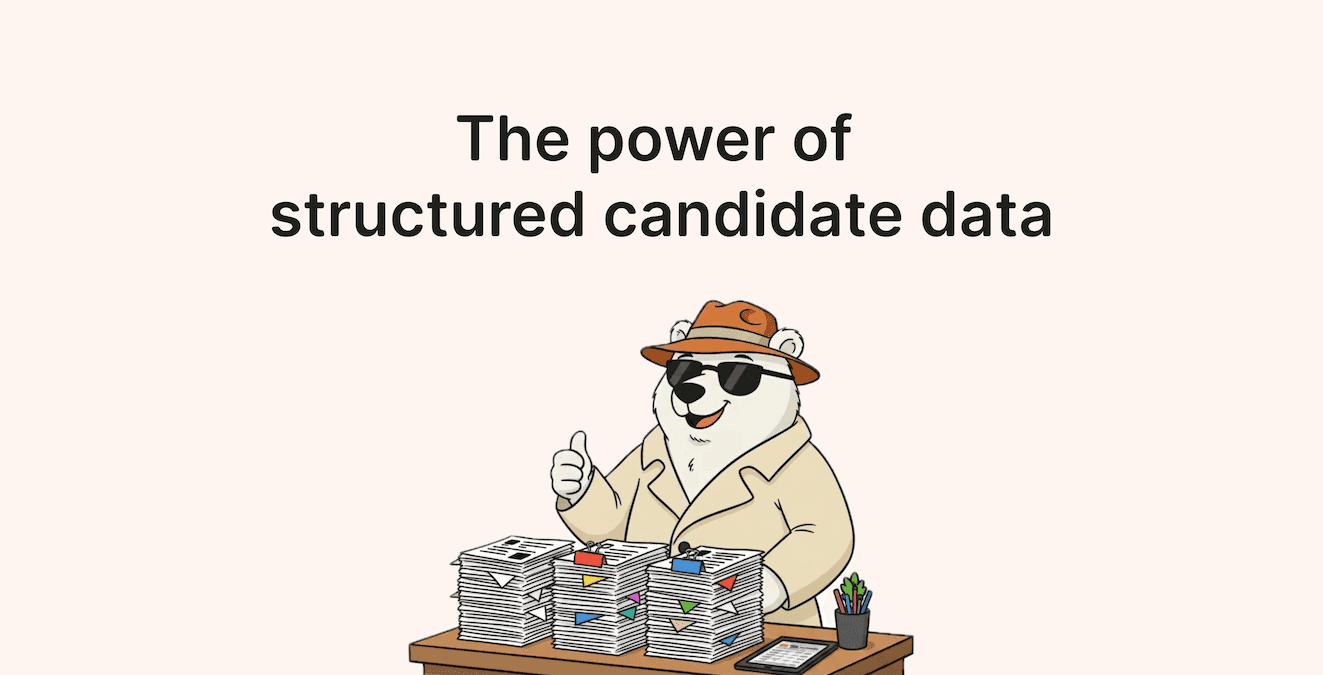
Structured candidate data is information extracted from CVs and organized into consistent, searchable categories. Instead of dealing with raw resume files in various formats and layouts, you work with clean, standardized profiles.
Think of it this way: a CV file is like a handwritten letter. Structured data is like a well-organized spreadsheet. Both contain the same information, but one is infinitely easier to search, filter, and compare.
When AI parses a CV, it typically extracts and organizes:
- Contact information (name, email, phone, location)
- Work experience (job titles, companies, dates, responsibilities)
- Education (degrees, institutions, graduation dates)
- Skills (technical skills, soft skills, certifications)
- Languages spoken
- Professional summary
All of this gets stored in dedicated fields and tabs within your ATS, ready to be searched, filtered, and compared at a glance.
The real cost of reading CV files manually
Manual CV review isn't just tedious — it's expensive. On average, a recruiter spends 6-8 seconds on an initial CV scan. But that doesn't include the time spent opening files, scrolling, extracting information, and entering data into your system.
For a single job posting receiving 250 applications, manual data entry alone can consume over 40 hours of work. That's an entire work week spent on administrative tasks instead of actually talking to candidates.
Beyond time, there are other hidden costs:
Inconsistency. When you're tired, you miss things. Important details slip through the cracks. The candidate with the perfect skill set gets overlooked because their CV had poor formatting.
Search limitations. Good luck finding that great candidate from six months ago when their CV is buried in an email folder somewhere. Even if you remember they exist, locating them requires digging through files manually.
Comparison challenges. Comparing candidates means opening multiple documents side by side, jumping between sections, and keeping mental notes. It's inefficient and error-prone.

How AI CV parsing changes everything
Modern CV parsing technology uses natural language processing and machine learning to read and interpret resumes automatically. When you upload a CV to an AI-powered ATS, the system:
- Identifies the document structure and sections
- Extracts relevant information from each section
- Categorizes data into standardized fields
- Creates a structured candidate profile instantly
The result? A clean, searchable candidate profile in seconds — not minutes. No manual data entry. No inconsistent formatting. No hunting for information.
At Adeptiq, we've built this directly into our platform. Our AI CV import feature lets you drag and drop any CV in PDF or Word format, and our AI extracts everything into structured tabs. Work experience, education, skills, and contact details — all organized and ready to use.
Five benefits of working with structured candidate data
1. Instant candidate comparison
When every candidate's information follows the same structure, comparison becomes effortless. You can view skills side by side, compare years of experience at a glance, and quickly identify who meets your requirements.
No more jumping between PDF tabs. No more forgetting what you read two candidates ago. With a well-organized job funnel, you can track candidates through your pipeline while having all their structured data available at every stage.
2. Powerful search capabilities
Structured data unlocks advanced search functionality. Want to find all candidates with Python experience in Antwerp who have worked in fintech? With structured data, that's a simple search. With raw CV files, it's an afternoon of manual work.
Some systems, including Adeptiq's AI search, even let you search using plain language — just type what you're looking for as if you were asking a colleague. This is only possible because the underlying candidate data is structured and searchable.
3. Building a real talent database
Every CV you process becomes part of a searchable talent database. When a new role opens up, you can instantly search your existing candidates instead of starting from scratch.
That perfect candidate who applied six months ago for a different role? They're one search away. This is the power of combining automated CV importing with structured data storage.
4. Faster time-to-hire
When you eliminate manual data entry and simplify candidate comparison, your entire hiring process accelerates. Recruiters using structured candidate data consistently report significant reductions in time-to-hire.
Speed matters. The best candidates are off the market within 10 days. If your process takes longer because you're manually processing CVs, you're losing talent to faster competitors.
5. Better candidate experience
A streamlined process isn't just good for recruiters — it's good for candidates too. Faster response times, fewer requests for information you should already have, and a more professional overall experience.
In a competitive talent market, candidate experience can be the difference between landing your top choice and watching them accept a competitor's offer.
What to look for in a CV parsing solution
Not all CV parsers are created equal. When evaluating options, consider:
Format support. Can it handle PDF, Word, and other common formats? The best parsers work with whatever candidates throw at them.
Accuracy. How well does it extract data from CVs with unusual formatting? AI-powered parsers that use machine learning typically outperform rule-based systems.
Integration. Is parsing built into your ATS, or is it a separate tool? Built-in parsing means one less system to manage and a smoother workflow. Look for systems where CV import feeds directly into your candidate pipeline.
Speed. How quickly are CVs processed? The best systems create structured profiles in seconds.
Ease of use. Does it require training to use, or can you start immediately? Simple drag-and-drop interfaces make adoption painless.
The future of candidate data
The shift from file-based to structured candidate data isn't just a convenience — it's becoming essential for competitive recruitment.
As AI capabilities continue to advance, structured data enables even more powerful features: automatic candidate matching, predictive analytics, and intelligent search that understands context rather than just keywords.
Recruiters who embrace structured data now will be well-positioned to take advantage of these innovations. Those still manually processing CVs will fall further behind.
Stop reading CVs. Start hiring.
The technology to eliminate manual CV reading exists today. AI-powered CV parsing transforms messy resume files into clean, structured candidate data — instantly.
At Adeptiq, we've built this capability into a simple, affordable ATS that just works. Upload a CV, and our AI does the rest. No complex setup. No training required. No enterprise pricing.
Ready to stop wasting time on manual CV processing?
Try Adeptiq for free and see the power of structured candidate data for yourself.
Looking to learn more about modern recruitment tools? Check out our guide on what an ATS is and why you need one.