Boolean Search vs AI Search in Recruitment: Which is Better?
In this guide, we'll compare boolean search and AI search, explain when each makes sense, and help you decide what's right for your recruitment workflow.

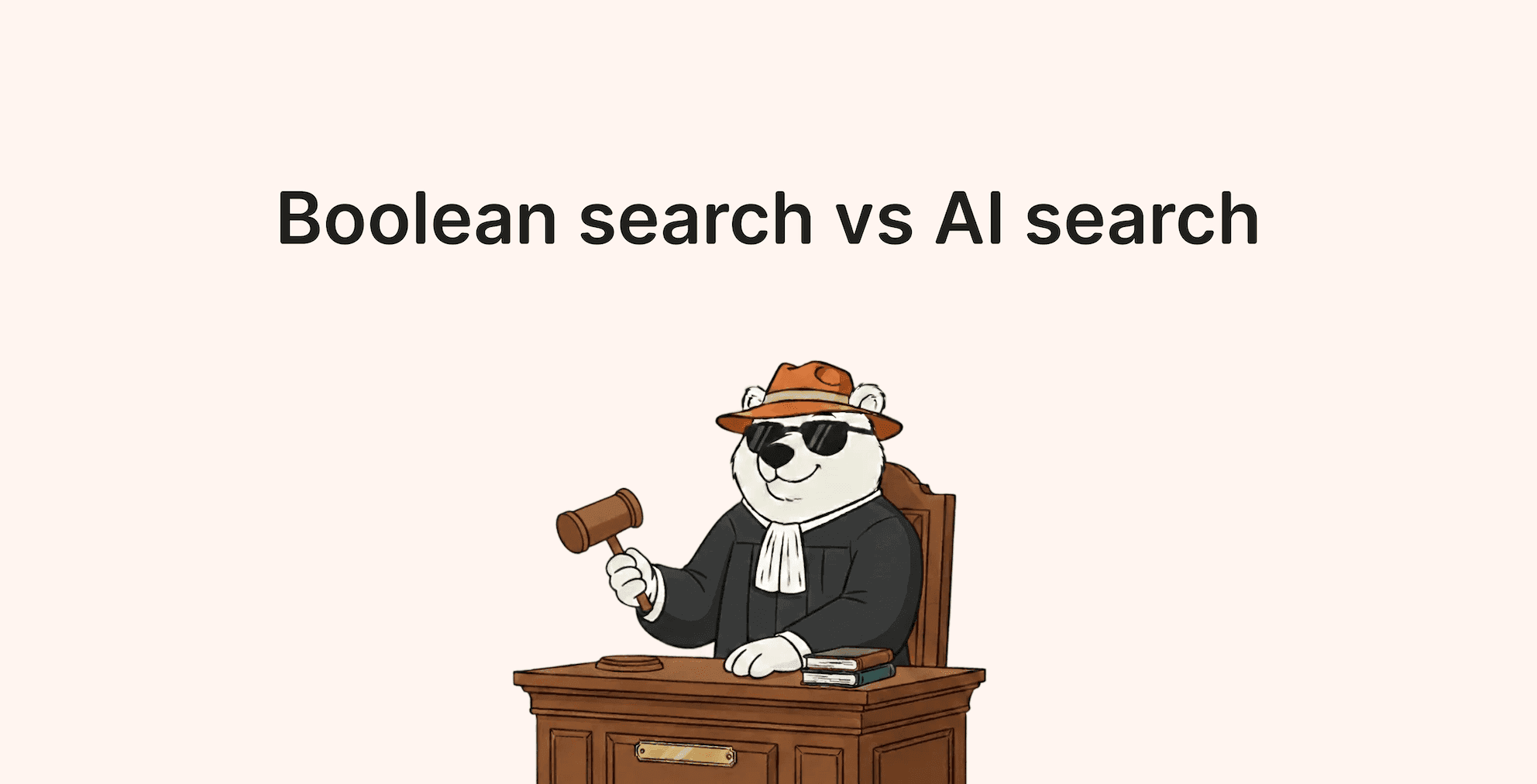
For decades, boolean search has been the recruiter's go-to method for finding candidates. Mastering operators like AND, OR, and NOT was considered an essential skill. But AI-powered search is changing the game, letting recruiters find talent using plain language instead of complex query strings.
So which approach is better? In this guide, we'll compare boolean search and AI search, explain when each makes sense, and help you decide what's right for your recruitment workflow.
What is Boolean Search?
Boolean search uses logical operators to combine or exclude keywords. It's named after mathematician George Boole and has been the standard for database searching since the early days of computing.
The Core Operators
AND — Both terms must be present
Returns candidates who have both "developer" and "python" in their profile.
OR — Either term can be present
Returns candidates who have "developer" or "engineer" (or both).
NOT — Excludes a term
Returns candidates with "developer" but excludes those with "junior."
Quotes — Exact phrase matching
Returns candidates with the exact phrase "product manager," not just those with "product" and "manager" separately.
Parentheses — Groups terms together
Returns candidates who are developers or engineers with either Python or Java skills.
A Typical Boolean String
Here's what a real recruiter's boolean search might look like:
This finds experienced software engineers with specific programming languages and cloud experience. It works—but it's not exactly intuitive.
The Problems with Boolean Search
Steep Learning Curve
Boolean logic isn't natural. Recruiters must learn syntax, remember operator precedence, and debug strings when results don't match expectations. Many never fully master it.
You Only Find Exact Matches
Boolean search is literal. If your string says "python" but a candidate wrote "Python 3" or "py," you might miss them. You need to anticipate every variation and synonym.
Keyword Stuffing Creates Noise
To cover variations, boolean strings become bloated. A thorough search might include dozens of OR statements for job titles, skills, and technologies—each one you forget is a candidate you miss.
No Understanding of Context
Boolean treats all keywords equally. It can't understand that a "Python developer with 5 years of experience" is more relevant than someone who "attended a Python workshop once." It just matches text.
Time-Consuming to Build
Crafting effective boolean strings takes time. Recruiters often maintain libraries of strings for different roles, copying and modifying them for each search. That's overhead that doesn't add value.
Different Systems, Different Syntax
LinkedIn Recruiter, job boards, and ATS platforms each have slightly different boolean implementations. A string that works perfectly in one system may fail in another.
What is AI Search?
AI search (also called semantic search or natural language search) lets you describe what you're looking for in plain English. The AI interprets your intent and finds matching candidates.
Instead of:
You simply type:
The AI understands what you mean and returns relevant results.
How AI Search Works
Natural Language Processing (NLP) breaks down your query to understand the intent, not just the keywords.
Semantic Understanding recognizes that "software engineer" and "developer" mean similar things, without you specifying every synonym.
Context Awareness considers how terms relate to each other. "Python" near "developer" means something different than "Python" in someone's interests section.
Machine Learning improves results over time based on what candidates recruiters actually engage with.
AI Search vs Boolean: A Direct Comparison
When Boolean Search Still Makes Sense
Boolean isn't dead. There are situations where it remains valuable:
Highly Technical Searches
When you need very specific technical combinations—exact certifications, specific tool versions, niche skills—boolean gives you precise control.
Compliance Requirements
Some organizations require documented, reproducible search criteria. Boolean strings provide an exact record of what was searched.
Platform Limitations
Not all systems support AI search yet. If your ATS or job board only offers boolean, you work with what you have.
Power User Preference
Recruiters who've mastered boolean may be faster with it for certain searches. Expertise has value, even if the tool is older.
When AI Search Wins
For most everyday recruiting, AI search is simply better:
Speed
Typing a natural sentence is faster than constructing a boolean string. You search more in less time.
Broader Results
AI finds candidates you'd miss with boolean because it understands synonyms, related terms, and context. You're not limited to exact keyword matches.
Accessibility
Junior recruiters can search effectively from day one. No training required—if you can describe what you want, you can find it.
Exploratory Searches
When you're not exactly sure what you're looking for, AI lets you iterate quickly. Try a vague query, see what comes back, refine naturally.
Reduced Bias
Boolean strings often encode assumptions (specific school names, company names, exact titles). AI search based on skills and experience can surface non-traditional candidates you'd otherwise filter out.
Real-World Example
Let's say you're looking for a marketing manager with B2B SaaS experience who knows marketing automation tools.
Boolean approach:
You spend 5 minutes building this, and you'll still miss candidates who wrote "demand generation" instead of "marketing manager" or use a tool you didn't list.
AI search approach:
You type one sentence. The AI understands what you mean and finds relevant candidates—including those with related titles and tools you didn't think to specify.
Making the Switch to AI Search
If you're currently relying on boolean, transitioning to AI search is straightforward:
1. Start Simple
Type what you'd tell a colleague: "Find me senior developers with React experience in Berlin." Don't overthink it.
2. Review and Refine
Look at the results. If something's off, adjust your query naturally: "Actually, I need someone with at least 5 years of experience."
3. Trust the AI
It takes time to stop thinking in boolean. Resist the urge to add operators. Just describe what you want.
4. Use Filters for Precision
Most AI-powered ATS platforms let you combine natural language search with filters for location, availability, or other hard requirements.
What to Look for in AI Search
Not all AI search is equal. When evaluating tools, consider:
True Semantic Understanding
Does it actually understand meaning, or is it just keyword matching with a chat interface? Test with synonym-heavy queries.
Speed
AI search should feel instant. If you're waiting more than a second for results, the system isn't optimized.
Accuracy
Run the same search multiple times. Do you get consistent, relevant results? Test edge cases.
Integration with Your Database
AI search is only useful if it's searching your candidates. Built-in search within your ATS is more valuable than a separate tool.
Conversational Refinement
Can you follow up with "show me only those who are currently available" without starting over? Good AI search maintains context.
Common Objections to AI Search
"I don't trust AI to understand what I need"
Fair concern. The solution is to verify results initially. You'll quickly learn what the AI handles well and where you need to be more specific.
"Boolean gives me more control"
It does—but do you need that control for every search? Use AI for 90% of searches and fall back to boolean for the complex 10%.
"What if the AI misses someone?"
Boolean misses candidates too—every synonym you forget, every variation you don't include. AI typically surfaces more candidates because it understands related terms.
"My team already knows boolean"
Great. They can still use it when needed. But new team members will ramp up faster with AI search, and everyone will save time on routine queries.
Final Thoughts
Boolean search was revolutionary in its time. It gave recruiters power over databases that would otherwise be unsearchable. But it was always a workaround—a way to communicate with machines that couldn't understand human language.
AI search removes that barrier. You describe what you want, and the system understands. It's faster, easier to learn, and often finds candidates that boolean would miss.
For modern recruiters, AI-powered search isn't just a nice feature—it's a competitive advantage. While others are debugging boolean strings, you're already talking to candidates.
The best recruiters will master both approaches. But when time matters and results count, AI search is the clear winner for everyday recruiting.
Ready to search your candidates like you'd ask a colleague? Try Adeptiq free and experience AI-powered candidate search.