Time to Hire: What It Is and How to Improve It
Time to hire isn't just an HR metric—it's a competitive advantage. The faster you move qualified candidates through your process, the more likely you are to land them before someone else does.

You finally find the perfect candidate. Great experience, right skills, enthusiastic about the role. You send the offer... and they've already accepted a job elsewhere.
Sound familiar? In today's market, top candidates are only available for about 10 days. Meanwhile, the average time to hire has stretched to 44 days. That gap is where you lose your best hires.
Time to hire isn't just an HR metric—it's a competitive advantage. The faster you move qualified candidates through your process, the more likely you are to land them before someone else does.
What Is Time to Hire?
Time to hire measures how long it takes from the moment a candidate enters your pipeline until they accept your offer. It's different from time to fill, which measures the entire process from job requisition to offer acceptance.
The formula is simple:
Time to Hire = Day candidate accepts offer − Day candidate enters pipeline
If someone applies on January 10th and accepts your offer on January 28th, your time to hire is 18 days.
Why does this distinction matter? Time to hire tells you how efficient your recruitment process is once you have candidates. Time to fill tells you how long it takes to fill a role from start to finish, including sourcing.
Current Benchmarks: How Do You Compare?
Recent data paints a clear picture of where the market stands:
These numbers have increased significantly. According to Gem's 2025 Recruiting Benchmarks Report, time to hire has grown 24% since 2021—from 33 days to 41 days. The culprit? Companies now conduct 42% more interviews per hire than they did three years ago.
By industry, hiring speed varies considerably (source: Workable):
- Construction: 12.7 days (fastest)
- Leisure & hospitality: 20.7 days
- Manufacturing: 30.7 days
- Professional services: 31.2 days
- Government: 40.9 days
- Financial services: 44.7 days
- Healthcare: 49 days
If your numbers are significantly higher than these benchmarks, there's room to improve.
Why Time to Hire Matters
You Lose Candidates to Faster Competitors
Top talent doesn't wait. When your process drags on, candidates accept offers from companies that moved faster. With 37% of recruiters citing competition from other employers as their biggest challenge, speed is a differentiator.
Candidate Experience Suffers
Research shows that reducing interview time by just 5 days can improve candidate Net Promoter Score by 20%. A slow, drawn-out process signals disorganisation—and candidates notice.
It Costs You Money
Every day a position stays open costs your business. Productivity drops, existing team members burn out covering extra work, and you keep paying for job ads. The average cost per hire is $4,700 according to SHRM—delays only add to that.
Your Best Candidates Come From Your Own Database
Here's a stat that should change how you think about hiring: 44% of sourced hires in 2024 came from candidates already in the company's ATS or CRM. That's up from 29% in 2021.
Your existing candidate database is a goldmine—but only if you can search it effectively. This is where most recruiters lose time: scrolling through spreadsheets, trying to remember that great candidate from six months ago, or rebuilding searches from scratch for every new role.
7 Ways to Reduce Your Time to Hire
1. Build a Searchable Talent Pool
Stop starting from zero with every search. The fastest recruiters maintain an organised database of past applicants, sourced candidates, and referrals.
But a talent pool is only useful if you can actually find people in it. If searching your database takes longer than posting a new job ad, something's broken.
This is exactly why we built AI Search in Adeptiq. Instead of constructing complex boolean queries or clicking through endless filters, you simply describe what you're looking for in plain language—like asking a colleague. "Java developer with fintech experience, open to contract work" returns relevant candidates in seconds, not hours.
2. Eliminate Manual Data Entry
Every minute spent copying information from CVs into your system is a minute not spent talking to candidates. Manual data entry is slow, error-prone, and—let's be honest—soul-crushing.
Modern CV parsing changes this completely. With Adeptiq's AI CV Import, you drag and drop a CV and the system extracts all the relevant information automatically: contact details, work history, skills, education. A task that used to take 5-10 minutes now takes seconds.
When you can process 50 CVs in the time it used to take to enter 5, your entire pipeline speeds up.
3. Streamline Your Interview Process
More interviews don't necessarily mean better hires. If you're conducting 20+ interviews per hire (the current average), ask yourself: is each one adding unique value?
Consider:
- Combining interview stages where possible
- Using structured interviews with scorecards to make faster decisions
- Setting maximum response times for hiring manager feedback
- Automating interview scheduling
4. Track Candidates Through a Clear Pipeline
When candidates get lost in the process—stuck waiting for feedback, unclear on next steps—your time to hire balloons.
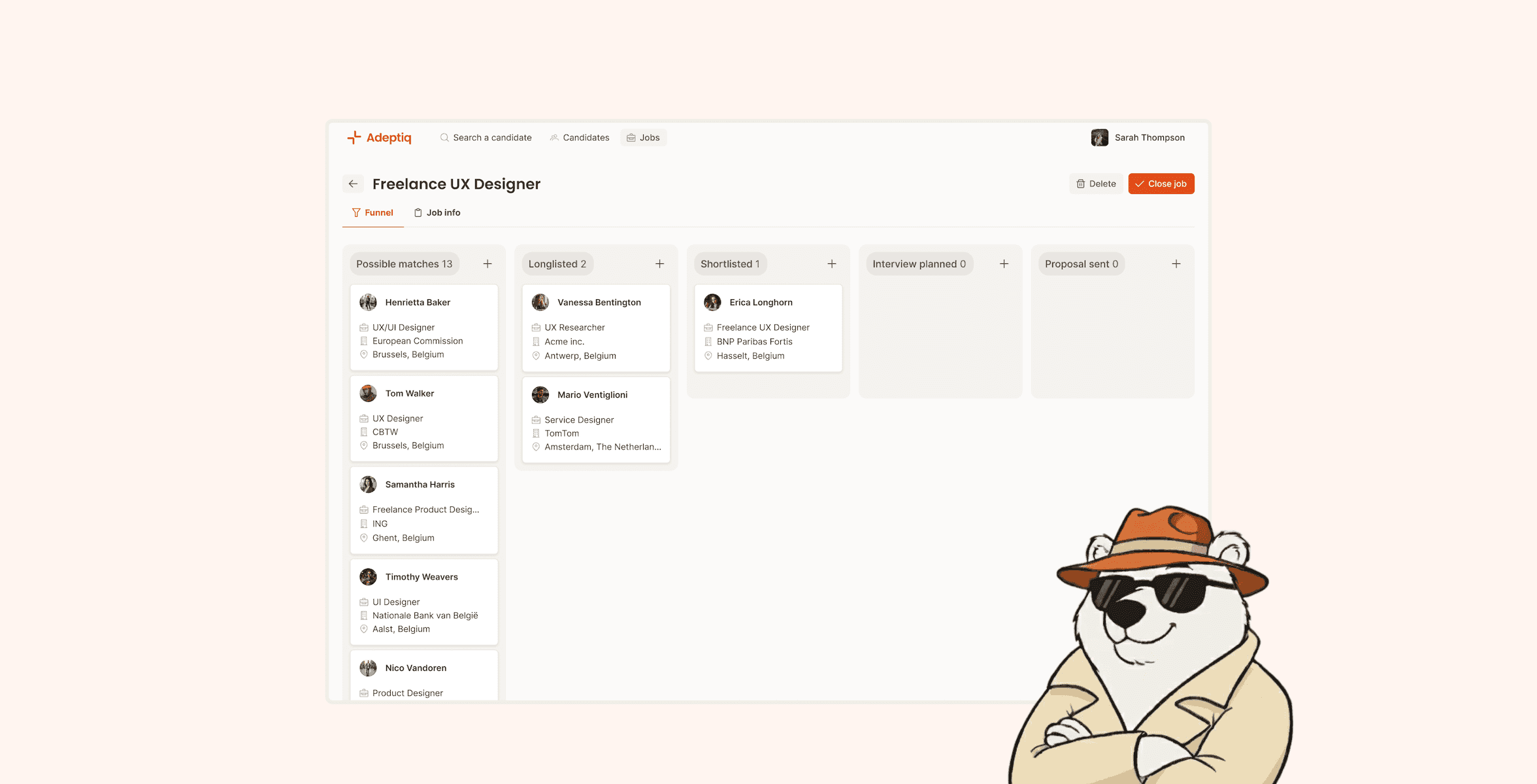
A visual job funnel keeps everyone aligned. You can see exactly where each candidate stands, who's waiting for action, and where bottlenecks are forming. No more digging through emails to figure out if someone's been contacted.
5. Set Internal SLAs
Create accountability with internal deadlines:
- CV review: within 48 hours of application
- First interview: within 5 days of shortlisting
- Hiring manager feedback: within 24 hours of interview
- Offer decision: within 48 hours of final interview
Track these metrics and address delays when they happen.
6. Pre-Screen Before You Interview
Not every applicant needs a full interview. Use phone screens, video introductions, or skills assessments to filter candidates before investing significant time.
When your ATS structures candidate data properly, you can quickly scan qualifications and experience without reading entire CVs. This is where structured candidate profiles save hours—the AI extracts and organises information so you can evaluate fit at a glance.
7. Communicate Proactively
Candidates who feel informed stay engaged. Send status updates even when there's no news. Let them know timelines upfront. Respond to questions quickly.
Silence kills deals. When candidates don't hear from you, they assume the worst—and keep interviewing elsewhere.
The Speed-Quality Balance
A word of caution: don't optimise for speed alone. Rushing leads to bad hires, and a bad hire costs far more than a slow one.
The goal isn't the shortest possible time to hire—it's the shortest time to hire the right person. That means:
- Fast sourcing and screening (where AI helps most)
- Thorough but efficient evaluation
- Quick decisions once you have the information you need
The biggest time savings come from eliminating waste, not cutting corners: faster database searches, automated data entry, streamlined scheduling, and clear pipelines. These don't compromise quality—they just remove friction.
How to Calculate Your Time to Hire
If you're not already tracking this metric, start now:
- For each hire, record the date they entered your pipeline (application, sourcing, referral)
- Record the date they accepted your offer
- Calculate the difference in days
- Average across all hires for your overall time to hire
Break it down by:
- Role type (entry, mid, senior)
- Department
- Source (inbound, sourced, referral)
- Recruiter
This helps you identify where delays happen and which parts of your process need attention.
Key Takeaways
- The average time to hire is 44 days—but top candidates are only available for 10 days
- 44% of hires come from existing databases—make yours searchable
- Reducing interview time by 5 days improves candidate satisfaction by 20%
- Speed comes from eliminating friction, not cutting corners: AI-powered search, automated CV parsing, and clear pipelines
- Track your metrics to identify bottlenecks and measure improvement
In recruitment, time is literally money—and candidates. The agencies that win are the ones that move fast without sacrificing quality.
Want to speed up your hiring process? Try Adeptiq free—with AI-powered candidate search, instant CV parsing, and a clear job funnel to keep your pipeline moving.